Showing posts with label Breads and pastries. Show all posts

Saturday, 5 March 2011

Simit: Turkish bread


Not a bagel, not croissant, not a baguette, but as good as if you like this kind of stuff…
This bread is very popular in Turkey and the middle street, is sold in the streets throughout the day as the vendors walk around with baskets or trolleys filled with the freshly baked rings covered with sesame seeds.

Simit is not your typical meals accompaniment bread. It is more for breakfast with jam and cheeses or for a light snack. I don’t even think that they use it for sandwiches.

For the texture, it is crunch from the inside and chewy and soft from the inside

Apparently, it is one of the things Turkish people miss most when they are abroad. How do I know!!! I am not Turkish, easy answer, I made it once, everybody at home loves it and we are already missing it.

Ingredients:
500g flour
1tbsp salt
1tbsp instant dried yeast
Warm water (roughly 300 ml)
A shallow bowl of sesame seeds
2 tbsp Pomegranate molasses diluted in 2 tbsp water
1 to 2 eggs (beaten)

Steps:

Preheat oven to 375 degrees.

1.      In a medium mixing bowl, sift together flour and salt. On a side add the dry yeast

2.      Make a depression in the dry ingredients with your fist, making a "hole" in the middle. Gradually add the warm water and use your hands to draw in the flour from the sides until you get soft dough.

3.      Knead the dough for 10 minutes until it is smooth and elastic

4.      Put the dough backing the bowl, cover with a damp cloth and leave to prove and double in size (1 hour or 2)

5.      Punch the risen dough and knock it back into a ball of dough.

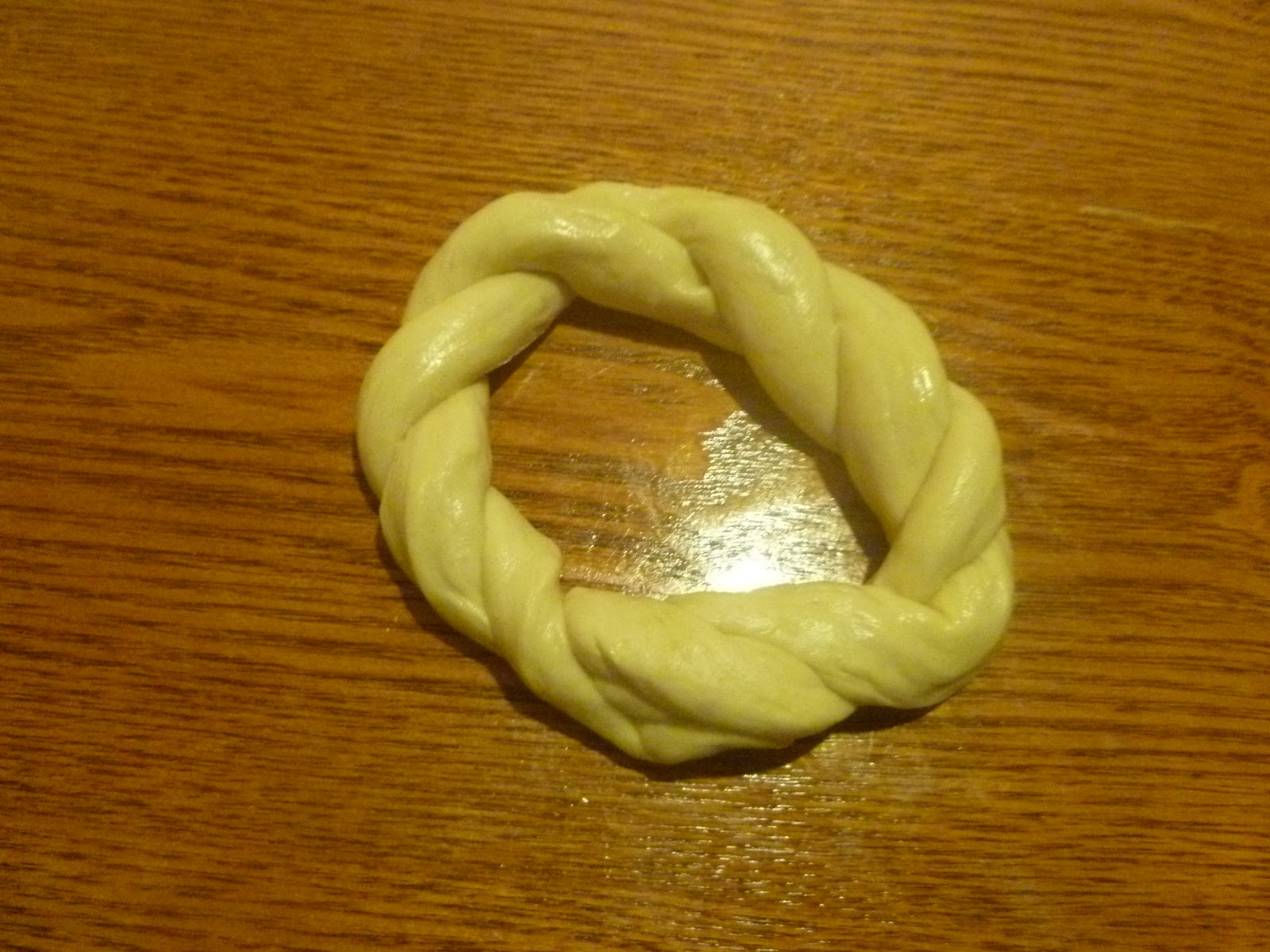
6.      Tear off pieces of dough (about 16). Use 2 balls of dough to make cigar shapes. Bring ends of "cigars" together to make a ring (look at picture).

7.      Dip the rings into diluted pomegranate molasses (in some water) or a beaten egg mixture, the dip again in a bowl of sesame seeds.

8.       Place circle on an oiled baking tray.

9.      Cover with a damp cloth and let rise again in a warm place for 30 minutes.

10.  Bake in a preheated oven (200ºC) for 20 to 30 minutes until golden brown

11.  Brush with milk. Sprinkle sesame seeds on top. Repeat with remaining dough.

12.  Bake for 30 minutes, or until simit become a golden brown color and crispy on top.


I tried few with black sesame seeds


My boys insisted on making their names with the last piece of dough
can you guess their names?

Sunday, 23 January 2011

Mahjouba or Mahajeb a la Biskria محجوبة أو محاجب بنكهة بسكرية


I love making Mahjouba even dough it is a time consuming task. I love kneading and stretching the dough, I like the smell in the kitchen; I like all the waiting and the excitement from the members of my family. My eldest son used to call it Mahbouba by mispronunciation (he was three) by we never corrected him as he was still right: Mahbouba means the loved one in Arabic.

Some people will be surprised by the addition of carrots in the filling. This the way it is done in Biskra ‘the capital of Mahjouba’ in Algeria and the hometown of my husband.
In Biskra, women developed an amazing skill of handling the dough and stretching it on their arms and they prepare Mahjouba not in square folded form but in thin stuffed discs.

I have been practicing this skill with my mother in law for few years now and I am nearly there inch Allah (God willing). I will take pictures or a video next time I do it this way in Algeria as I need a bigger griddle which is not available in the UK.

Linguistic note: Mahjouba means the covered one… Got it!!!


Ingredients:
Filling:

6 onions (finely chopped: I use the food processor)
2 grated carrots
1 tablespoon concentrated tomato puree
½ tin chopped tomatoes
3 tablespoons olive oil
A handful of chopped coriander
Salt & pepper
1 hot pepper (optional)

Dough:

750 g fine semolina
2 tbsp salt
Water (about 800ml)

Steps:

1.     Fry the onions and carrots in a little olive oil until softened (covered in a heavy bottomed pot).
2.     Add the tomatoes (both types), salt and pepper and cook covered, for approximately another 15 minutes. The mixture should have reduced (no more liquids) and improved in flavours.
3.     Add chopped coriander and Set aside to cool.


1.     Mix semolina and salt. Slowly add water until you get a ball of dough.
2.     Keep sprinkling more water (gradually) and work the dough vigorously until it becomes soft but not sticky.
3.     Oil your fingers; divide the dough into small balls about the size of an egg. Put them on an oiled tray, cover and let it stand for 30 minutes
4.     Spread dough on an oiled surface, by flattening and stretching it to form a very thin sheet.
5.     Spread a tbsp of stuffing in the middle of the sheet.
6.     Fold two sides of the sheet, then the other two to form a square.
7.     Drizzle with oil and bake on a lightly oiled griddle or a good quality frying pan


Monday, 17 January 2011

Rakhssess رخساس


Ingredients:
4 mugs  fine semolina
½ mug oil (olive oil or half /half with vegetable oil)
1 tbsp salt
Water
Steps:
1.      Mix semolina with salt and oil
2.      Slowly add water and knead to get a soft dough (because of the amount of water and the consistency of semolina, the dough will have a crumbly consistency)
3.      Leave to rest for 5 to 10 minutes. Divide into 3 balls and flatten them with the rolling pin. Prick with the fork and get ready for cooking
4.      Heat a heavy frying pan, I like using pancake griddle. Cook the flat breads on both sides (avoid over handling the dough so it doesn’t break ) until bread is cooked and is of a golden colour


Thursday, 6 January 2011

Kessra كسرة 'Algerian flat semolina bread'


The word Kesra in Arabic means a fragment or a piece of something. In Algeria (and Sudan), it refers to a kind of everyday flat bread. Other kinds of bread are called Khoubz. Although homemade bread is confined to rural areas in most Arab countries, Kesra is still made on a regular basis in most Algerian homes. For this purpose, all households are equipped with a tabouna (a kind of small gas cooker), a tagine (flat clay griddle) and a tawa (metallic griddle).

The tagine is also called ‘el-farrah’ in parts of Algeria meaning the ‘one who brings happiness’ especially to kids waiting for the first bread to be ready.

My mum used to say, if you have semolina and a tagine, your family will never go hungry. Algerian love this bread, I have a sister who will hide fresh baguettes in the freezer to make sure we get Kesra with our dinner.

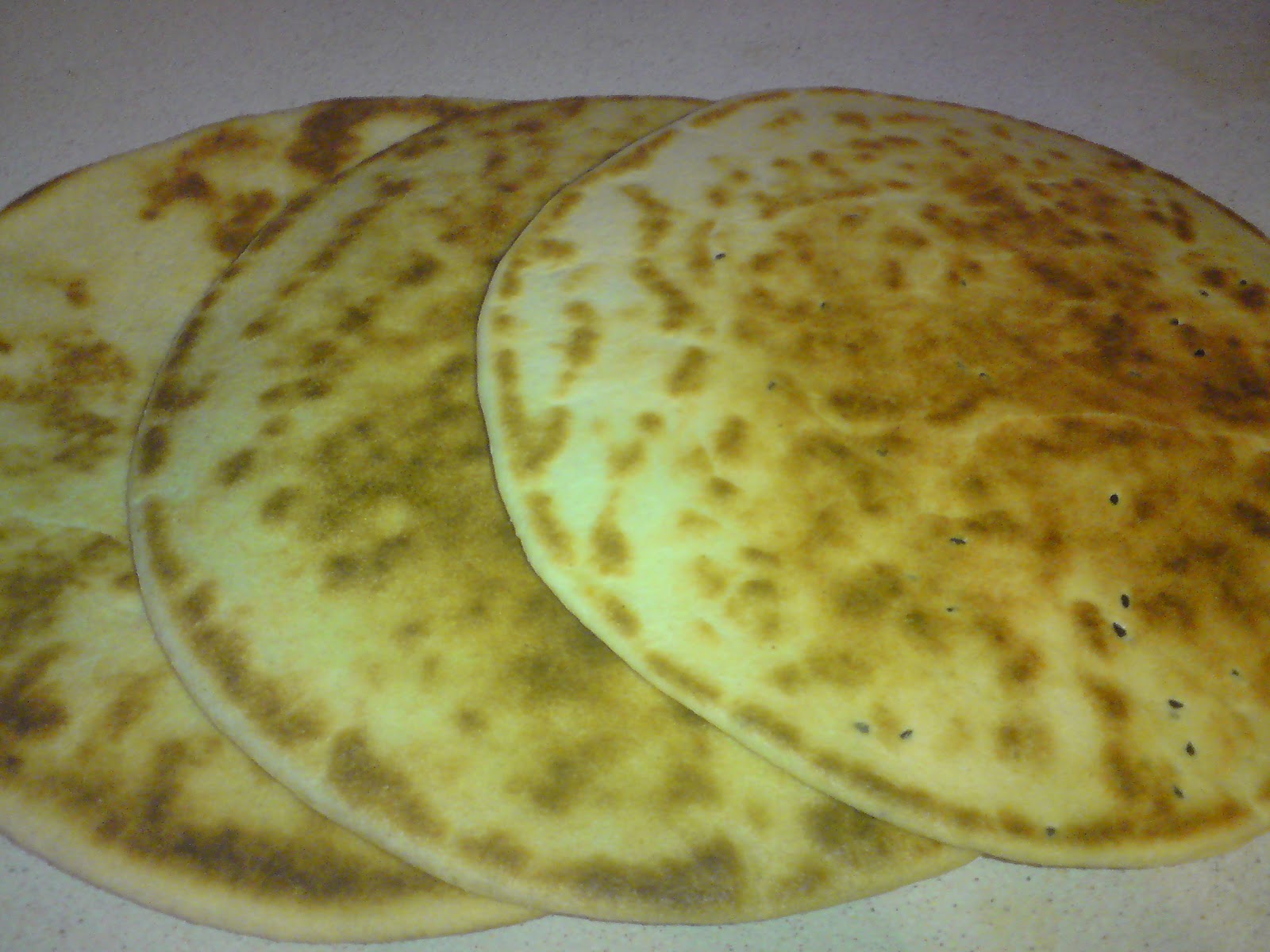
The recipe I am giving you today uses semolina, a bit of oil and yeast. It produces a bread with a soft kind of crumbly texture. It is quick and easy to make. It goes with most of savoury or sweet accompaniments. There are another two kinds of Algerian flat breads;

·         Rakhssess رخساس: thin, dense and crumbly: no yeast but more oil.
·         Matlou’ or  Khmira مطلوع، خميرة: thick, soft and chewy: no oil more yeast.

I will give recipes another day

Kessra
  
Ingredients: makes 4 medium flat breads

5 mugs fine semolina
½ mug vegetable oil (or olive oil)
2 tbsp salt
2 tbsp dry yeast
Warm water (about 2 mugs)
Optional: Black sesame seeds (also known as Nigella or black cumin)

Steps:
  1. In a big mixing bowl, mix all the ingredients except water
2.      Slowly add water to make a soft but firm dough
3.      Knead for 10 minutes until you reach a smooth consistency
4.      leave to rest for 10 to 15 minutes (sometimes I don’t and it is still OK)
5.      Divide the dough into 4 equal balls
6.      Heat a heavy frying pan (I get best results with a pancake pan)
7.      Roll the balls into disks with ½  to 1 cm thickness
8.      Prick the surface with a fork and dry cook both sides on medium heat until surface is golden brown
9.      To add flavour and texture, you can add 1 tbsp of black sesame seeds to a piece of dough, knead again to spread seeds evenly before rolling and cooking
10.  Cut into pizza wedges style and enjoy warm or cold