Showing posts with label Tarts and puddings. Show all posts

Monday, 7 March 2011

'Bouza bil halib' بوضة بالحليب milky ice cream with sahleb 'orchid'


Ingredients:
1 litre of milk (4 cups)
1 cup of sugar
1 cup of sahleb powder
1 tbsp orange blossom water
½ tsp mastic pounded with ½ tsp sugar
Pistachios for decoration


Steps:


1.      Mix the sahleb with a little of the mil, Boil the rest of the milk in a saucepan after you added the sugar (keep stirring all the time).
2.      Add some of the hot milk to the sahleb paste, then gradually mix in the rest of the milk, add the mastic powder.
3.       Stir vigorously until it is all dissolved and simmer over low heat for about 15 minutes until it is tick (keep stirring from time to time).
4.      Mix in the orange blossom water and pour the mixture into a bowl for the freezer.
5.      leave it to cool, then cover and freeze, beating at intervals to avoid the formation of crystals (I used an electrical hand mixer and it added air to the mixture)
6.      Take out of freezer 10 minutes before serving, spoon the ice cream into bowls and sprinkle with chopped pistachios

Saturday, 5 February 2011

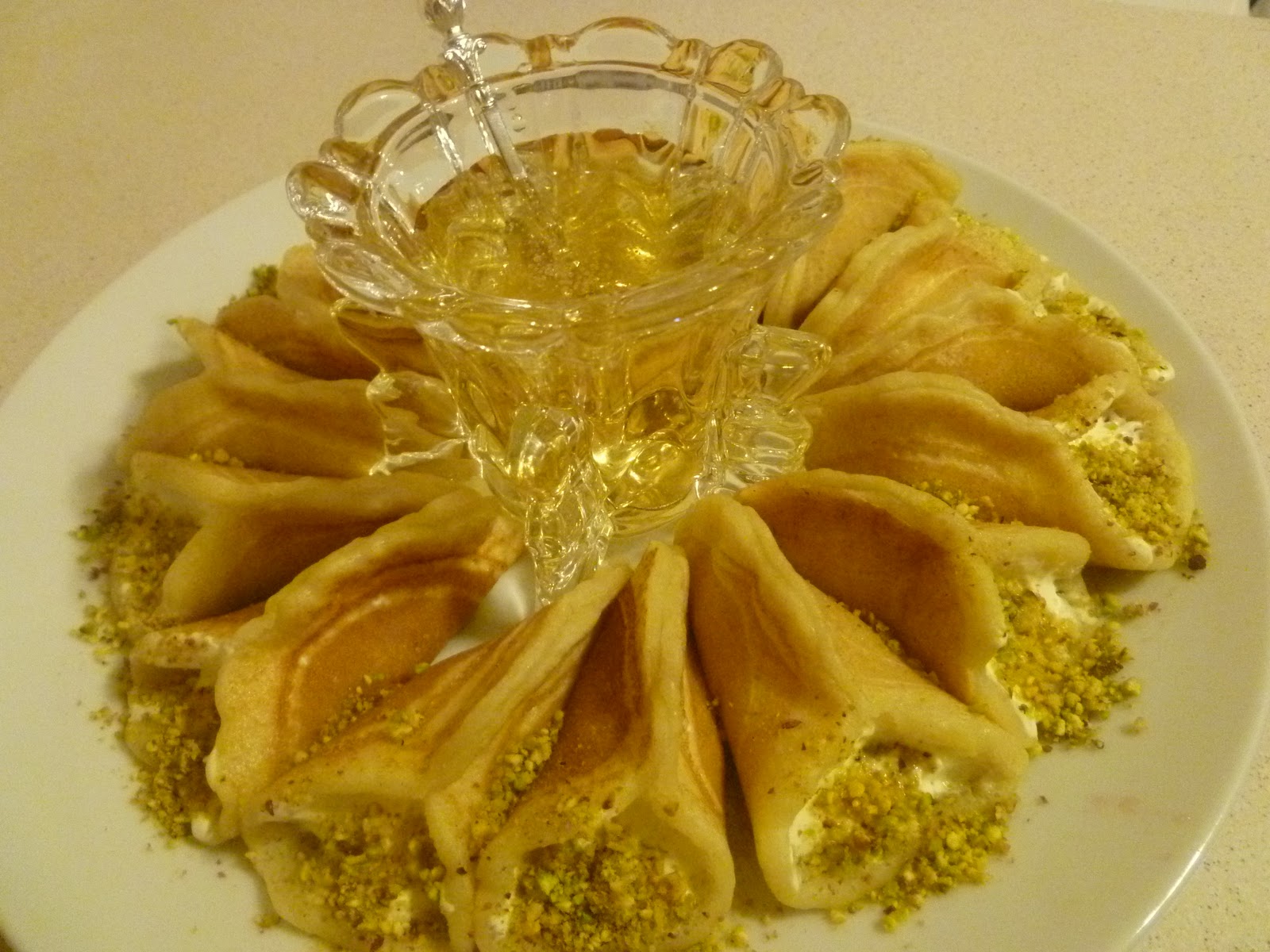
'Assafir': cream filled Ataif عصافير


'Assafir' or 'birds is another way to serve Ataif that doesn't involve frying or baking. go to my previous recipe: just make the pancakes as small as you can (mine are still too big).
Fill them as seen on the pictures with ricotta cheese or crème fraiche (I like the tangy taste).
Decorate with pistachios and tick syrup.


Thursday, 3 February 2011

Strawberry tarts 'Skikda' style


When it comes to sweet things, I am more into tarts than cakes, and my favourite one is strawberry tart. No surprise if you know that I grew up in Skikda (north east of Algeria), a city famous for the production of one of the best strawberries in the world; ‘la fraise de Skikda’, also known as the Russicade (Roman name of the city).
This variety was introduced in the 1920’s by an Italian ‘colon’ in the 1920’s. The actual Russicade is the result of several mutations and also of the way the first plant adapted to the climate of Skikda.
The Russicade is distinguished by a small size (which makes it very fragile), a very strong fragrance, the abundance of its juice and the absence of any acidity, neutralised by very high sugar levels
The Russicade is celebrated in Skikda by a 3-day festival at the end of May every year. The program include
·         Best strawberry cake
·         Best bakery window display
·         Best jam
·         Sports competitions
·         Musical evenings
·         And even a Beauty competition ‘Miss Farawla’ (sorry but I am not fun of this kind of competitions)


Here is a link for more pictures of the festival

In this recipe, I included two kinds of creams for the filling
1.      Light version: Milky cream
2.      Rich version: Pastry cream also known as crème patissière

I used the first one in my recipe because I just felt like it that day, Anyway you can also use cream or crème fraîche if you feel like it as well…..


Ingredients:
For the sweet pastry – pâte sable


250g plain flour
125g caster sugar
125g butter, chilled and cut into small pieces
1 large egg, beaten

For the filling

1 kg strawberries
3 tbsp strawberry jam mixed with some water for a runny consistency

Filling1: Milky cream
2 cups Milk
1/4 cup Cornflour
1/4 cup Sugar
1 tsp vanilla essence

Filling1: Pastry cream
2 cups Milk
3 egg yolks
2 tbsp Cornflour
1/4 cup Sugar
1 tsp vanilla essence


Steps:
Pastry

 
1.      Place the flour and sugar in a food processor and whizz for thirty seconds. Turn the processor back on and add the chilled butter and finally the egg. If the pastry needs a little more liquid add a spot of water until the dough rolls cleanly round the bowl.
2.      Wrap your pastry in Clingfilm and chill for half an hour whilst you prepare the tartlet tins and strawberries.
3.      Roll out and use to line the tins. Prick the bases and bake blind for 10 to 15 minutes.
4.      Mix together the sugar, cornflour and vanilla essence (add the egg yolks if you are making filling2) with some of the milk. Heat the rest of the milk in a saucepan just to boiling point, cool slightly, then whisk into the previous mixture, return to the pan and slowly bring to the boil. Cover the surface of the mixture with dampened paper to cool
5.      Fill the tartlets with the cold cream and fruits. Glaze with runny strawberry jam


Oven baked Ataif (cheese or nuts filling) قطايف في الفرن


Ataif is one of the sweets associated with Ramadan in the Middle East. Most people in the Middle East buy ready made pancakes from bakeries and finish the last stages at home as it is best eaten on the same day. Long time ago one of my Lebanese friends used to bring trays full of this sweet to our local mosque (Aberdeen Scotland) during the month of Ramadan. It was so popular that the tray was gone in a flash. My dear Lebanese friend left few years ago, but we are again enjoying them from her young but talented daughter in law.

I experimented with 3 Ataif recipes as some recipes use yeast and others use a mixture of Semolina and flour. My friend F. advised me to use flour (only) and baking powder to avoid having holes in the outside surface of the pancakes.

I also baked the Ataif instead of frying them and my husband who likes them fried thinks the result is very nice.

In memory of my Lebanese friend, I took some of it to the mosque at the week end for the ladies study circle.

Ingredients:

Syrup:
2 cups granulated sugar
2 cups water
1 tbsp lemon juice
2 tbsp orange blossom water

Batter:
2 tsp baking powder
1 tsp granulated sugar
2 cups water
2 cups all-purpose flour

Cheese Filling:
1 tbsp per pancake ricotta cheese

Nut Filling:
2 cups ground walnuts or pistachios
1/4 cup granulated sugar
2 tsp ground cinnamon

Topping
1/2 cup coarsely chopped pistachios or walnuts

Oil for brushing or frying

Steps:


Syrup:
1.      Make syrup in a heavy saucepan by melting sugar in water and boiling the liquid for 10 to 15 minutes until the syrup is thick enough to coat a cold metal spoon.
2.      Turn off the heat and stir in the orange flower water and the lemon juice

Batter:
1.      Mix all the ingredients in an electric blender and blend until you have a smooth batter. You might have to use a spoon to check if any flour is still sticking to the bottom of the blender.
2.      Leave mixture to rest for 15 to 30 minutes. You will see that bubbles are forming on the surface
3.      Lightly oil a heavy frying pan or griddle, and turn up the heat to high, until the pan is thoroughly heated. Reduce the heat to medium to maintain a steady temperature. Pour 1 tablespoon of batter into the pan and fry the pancake until small bubbles form on the surface. Remove the pancake to a platter and continue until the batter is all used up.
4.      Spoon a tablespoon of filling (ricotta cheese or nut filling) onto the uncooked centre of each pancake.
5.      Fold the pancake over the filling and pinch gently around the edges so that they will stick together.
6.      Cook the filled pancakes on a oiled baking tray (brush the surface of the pancakes with oil as well) for 30 minutes in a preheated oven (200ºC) until it is golden and crunchy
7.      You can also deep fry them
8.      Dip the hot pancakes into the cold syrup, remove with a slotted spoon, and arrange on a serving platter. Sprinkle with chopped nuts.


Sunday, 23 January 2011

Bassboussa with a Turkish twist (Semolina cake with pistachios and oranges)


This is a twist on my standard Bassboussa recipe which uses oranges and pistachios instead of lemons and coconut. It was inspired by a Turkish semolina pudding.

Ingredients: makes 40 pieces

4 eggs
1 cup caster sugar
1 cup plain yoghurt
1 cup vegetable oil
1 cup finely chopped pistachios
2 cups fine semolina
1 tbsp baking powder
Zest of 1 orange

Syrup:

1 1/2 mugs caster sugar
1 mug freshly squeezed orange juice
1 mugs water
1 lemon

Steps:
  1. In a pan dissolve the sugar in the water and orange juice to make the syrup. Boil on medium heat for 8mn. Then add rind of the orange.
2.      Mix eggs, sugar, yoghurt, oil, orange zest and pistachios. Whisk the mixture for 1mn, and then add semolina and baking powder. Leave to rest for 15mn.
3.      Empty mixture into a rectangular deep baking tray and bake for about 25mn in a preheated oven (180°C) until you get a golden colour.
4.       As soon as you get the cake out of the oven, pour syrup over the cake (discard the lemon rinds) keep pouring gradually until you feel the cake stopped absorbing the syrup. Dust with chopped pistachios.


Sunday, 9 January 2011

Rfiss Zirawi الرفيس الزيراوي


In Algeria and especially in the North East, we prepare the delicious Rfiss Zirawi to celebrate different special occasions (wedding, engagement, circumcision, or even for passing the baccalaureate exam). It is a convivial dish as it can be enjoyed individually or by a group of people sitting around a circular table and helping themselves from a big plate. It is a sweet pudding made from semolina and it is always eaten hot accompanied by a nice cold glass of lben لبن (buttermilk).

My eldest son loves it very much and the last time he ate it, he made a funny act copying Jamie Oliver (British TV cook) and said ‘hum……packed with flavours’.

The traditional recipe calls for far more butter and honey than my recipe!!! But it is still nice.


Ingredients: serves 10
3 mugs of coarse semolina
½ cup of oil or melted butter
1 tbsp salt
Milk
Orange blossom water
Icing sugar
Honey
2 cups Walnuts

Steps:
1.      Mix the semolina, salt, oil, 2tbsp of orange blossom water until all blended. Add water slowly until you get a firm dough
2.      Preheat the oven (2000C), spread the dough in a deep baking tray and using a knife cut the dough horizontally and vertically to have small squares. This will help when moving to the next step
3.      Cook for ½ an hour or until the top of the dough turns takes a golden colour
4.      Leave the dough to cool down and put the pieces of cooked dough in batches in the food processor and grind them to a coarse consistency (a little bit like couscous
5.      because you do not grind them finely there will still be some bigger chunks, don’t worry because you will pass it through the sieve and put what didn’t go through it back to the food processor to be grinded with the next batch
6.      Get a cousscoussiere (couscous steamer double pot) ready. Add 1 cup of  half milk half orange blossom water to the Rfiss preparation and mix with both hands
7.      Stream the preparation for ½ and hour until it starts to soften
8.      Empty the preparation in a big mixing bowl add another cup (or 1 and ½ cup) of milk, mix thoroughly, then steam again
9.      Pass through the sieve
10.  Add 6 tbsp of butter, 4 tbsp of honey, 4 tbsp of icing sugar and 1 cup of coarsely crushed walnut.
11.  Dress up in a big serving bowl or individual cups, decorate with icing sugar, walnuts halves and a drizzle of honey (put more if you want)
12.  Serve hot with cold buttermilk


Thursday, 30 December 2010

Basboussa بسبوسة (Moist Semolina Cake)


I can still remember the first time I made Basboussa as it was my first cake at the age of 8. At that time I used my mum's recipe and I, like everyone in the family called it 'Gateau de Semoule' meaning semolina cake in French. My recipe's name evolved to Basboussa at the same time it evolved with the use of yoghurt and coconut thanks to my Lebanese friends here in Aberdeen. One of my colleagues in work likes it very much and calls it the 'Halal Rhum Baba ' because it has a similar texture without the addition of Alcohol.
I searched for the origin of the word Basboussa itself without success, so let me know if you happen to know about it. What I know is that it is known under different names (Hareessa, Mamounia, Kalb elouz and Revani) in the Arab world, Turkey and Greece.
There are so many versions of Basboussa, there is a least one per family. Some prefer it light and refreshing with yoghurt and light syrup and others prefer it loaded with ghee (clarified butter) honey and nuts. I even tried it recently with a creamy filling.
I enjoy a bite from the heavy ones but I prefer the lighter version which I am giving you today

Ingredients: makes 40 pieces

4 eggs
1 cup caster sugar
1 cup plain yoghurt
1 cup vegetable oil
1 cup desiccated coconut
2 cups fine semolina
1 tbsp baking powder
Zest of 1 lemon

Syrup:

2 mugs caster sugar
2 mugs water
1 lemon

Steps:
  1. In a pan dissolve the sugar in the water to make the syrup. Boil on medium heat for 8mn. Then add the juice and rind of the lemon.
2.      Mix eggs, sugar, yoghurt, oil, lemon zest and coconut. Whisk the mixture for 1mn, and then add semolina and baking powder. Leave to rest for 15mn.
3.      Empty mixture into a rectangular deep baking tray and bake for about 25mn in a preheated oven (180°C) until you get a golden colour.
4.       As soon as you get the cake out of the oven, pour syrup over the cake (discard the lemon rinds) keep pouring gradually until you feel the cake stopped absorbing the syrup. Dust with desiccated coconut.